


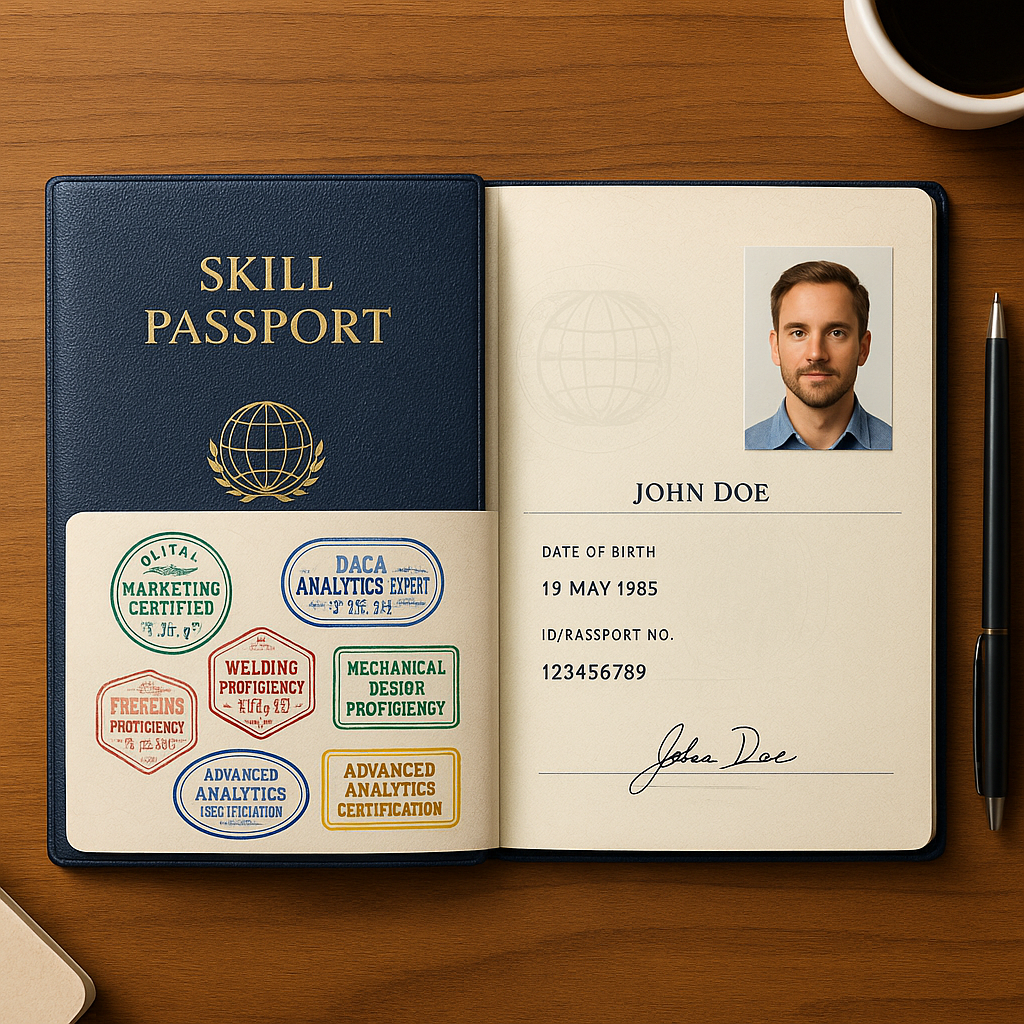
For centuries, the university degree has stood as the ultimate symbol of intellectual achievement and employability — a passport to opportunity and respect. Yet, as we approach the midpoint of the 21st century, the unquestioned dominance of traditional degrees is fading. Employers increasingly acknowledge that degrees alone no longer guarantee job readiness. In a world transformed by automation, artificial intelligence, and accelerated digital change, the half-life of knowledge is shrinking. Skills acquired a decade ago may already be outdated.
In response, a new paradigm is emerging: skills passporting. This concept refers to a unified, verifiable portfolio of an individual’s competencies — encompassing academic qualifications, professional certifications, and practical achievements — all stored and validated through digital technologies such as blockchain.
For Asia with over 700 million people under the age of 25, the region’s potential workforce could be its greatest strength or its biggest vulnerability, depending on how well it adapts to the future of work.
The rise of skills passporting signals a global transformation — a move from education as a one-time event to education as a lifelong, evolving journey.
Why Skills Passporting Is Redefining Competence
Across industries, employers are voicing a common concern: many graduates enter the workforce lacking the “job-ready” skills necessary for success. The World Economic Forum’s Future of Jobs Report (2025) estimates that nearly 44% of workers’ core skills will change by 2030, yet higher education models remain largely anchored in outdated frameworks.
This persistent skills gap — the divide between what students learn and what the market demands — has opened space for alternative pathways. Bootcamps, short-term courses, and industry certifications are flourishing, emphasizing applied learning and employability over academic theory. Platforms like Coursera, Udemy, and LinkedIn Learning are now global classrooms, delivering micro-credentials that can be earned, shared, and verified almost instantly.
However, this explosion of online learning has created a new challenge: credibility. With thousands of providers issuing digital certificates, employers face growing difficulty discerning which credentials are legitimate and which lack substance.
Enter blockchain-based credentialing — a technology designed to secure, authenticate, and decentralize qualification records. A blockchain-enabled skills passport allows every certification, badge, or achievement to be validated in real time. It is portable, tamper-proof, and universally trusted.
In effect, the résumé of the future is no longer a static document but a dynamic, digital record — an evolving ledger of skills that grows as individuals learn, reskill, and adapt throughout their careers.
Global Experiments That Are Rewriting the Rules
Around the world, governments and institutions are already experimenting with systems that redefine how credentials are issued and recognized.
The European Union has pioneered the EU Digital Credentials Framework, an initiative that underpins the European Skills Passport. This framework enables citizens to store and share verified educational and professional records across borders — creating seamless recognition of skills throughout member states.

Singapore’s SkillsFuture has set a global benchmark for lifelong learning. The initiative provides every citizen with learning credits that can be used throughout their career to acquire verified skills aligned with national and global industry needs. Each credential earned contributes to a secure digital portfolio that employers can easily verify.
Australia’s My eQuals platform represents another milestone. A collaboration among all 47 Australian and New Zealand universities, it issues digital diplomas, transcripts, and certificates through a centralized and secure system — giving graduates global mobility and employers instant validation.
Private players are also reshaping the space. Coursera, LinkedIn, Google, and IBM have all launched digital badge ecosystems that verify job-relevant skills. IBM’s “Open Badges,” for instance, are now recognized by corporations and universities worldwide, integrating industry expertise into formal education pathways.
Together, these initiatives mark a clear trend: the decentralization of credentialing. Learning and validation are no longer confined to universities. Instead, they are being distributed across a global network of academic institutions, governments, and private sector leaders — each contributing to an interconnected ecosystem of lifelong learning.
Asia’s Opportunity: Bridging Education and Employability
For Asia — home to the world’s largest youth population — the implications of skills passporting are enormous. With over 700 million people under the age of 25, the region’s potential workforce could be its greatest strength or its biggest vulnerability, depending on how well it adapts to the future of work.
| Year | Market Size (USD Billion) | Notable Growth Events | Key Regions Leading Growth |
| 2019 | 9.9 | Pre-COVID baseline | North America, Europe, Asia-Pacific |
| 2020 | ~12.5 | Rapid growth due to pandemic adoption | North America, Europe |
| 2021 | ~15.9 | Major EdTech platforms expansion | Asia-Pacific sees digital surge |
| 2022 | ~23.0 | Corporate uptake and employer acceptance | India and China strong upskilling |
| 2023 | ~36.7 | Integration in formal education and hiring | Global surge, EU frameworks |
| 2024 | ~51.0 | Accelerated global adoption, major scale-up | US, EU, APAC |
Across India, Southeast Asia, and the Middle East, employability gaps remain significant. A McKinsey study reveals that nearly 60% of Asian employers struggle to find candidates with the right mix of technical and soft skills. Traditional degrees, while still respected, often fail to capture the full range of capabilities needed in fast-evolving industries such as AI, fintech, sustainability, and digital health.
A blockchain-based skills passport could change this narrative. Imagine a graduate from Indonesia sharing verified credentials — from a local university, Coursera, and a government skilling program — with an employer in Dubai, seamlessly and securely. Verification becomes instant, and opportunity becomes borderless.
Governments in Asia are already moving in this direction. India’s Skill India Mission and National Skills Qualifications Framework are exploring the integration of digital credentialing. The UAE aims to become a regional hub for blockchain-verified education. In Malaysia and Thailand, ministries are partnering with EdTech platforms to embed micro-credentials into national qualification systems.
However, this transformation faces challenges. The digital divide — limited access to devices, connectivity, and digital literacy — threatens to exclude rural and underprivileged populations. Cultural inertia is another hurdle; many employers still view formal degrees as the only credible measure of ability.
Nonetheless, the trajectory is unmistakable. Skills passporting aligns perfectly with Asia’s push toward a skills-first economy — one that values competencies, creativity, and adaptability over pedigree. For a region as diverse and dynamic as Asia, this shift could finally make employability equitable, inclusive, and globally recognized.
The Future of Learning: Hybrid Credentials and Lifelong Verification
So, will skills passports replace degrees? Not entirely — at least not yet. Instead, the world is moving toward hybrid credentialing ecosystems, where traditional degrees coexist with modular, stackable, and continuously updated credentials.
By 2030, education may function more like an open marketplace than a linear pipeline. Learners will mix and match university courses, micro-certifications, apprenticeships, and real-world projects to build customized learning pathways. Institutions will evolve from gatekeepers of knowledge to partners in lifelong learning, issuing verifiable credentials that update as individuals evolve.
Employers will adapt too. Recruitment systems will focus on competencies rather than qualifications. AI-powered hiring tools will assess verified digital profiles to identify precise skill matches, while blockchain ensures authenticity.
| Dimension | European Union | Asia |
| Launch Year | 2023 (EU Digital Skills Passport) | 2019–2025 (varied by nation, UNESCO pilots) |
| Scope | Pan-European, supports cross-border mobility | National and regional, less cross-border |
| Integration | Micro-credentials, formal & informal learning | Technical, vocational, and professional skills |
| Recognition | Automatic in EU, driven by EU-wide standards | National standards, aspiring to international |
| Digital Features | Linked with digital ID and secure digital wallet | Mobile-based platforms, some blockchain pilots |
| Target Groups | All working-age adults, unemployed, students | Workforce, displaced persons, students |
| Main Goal | Lifelong learning, mobility, competitiveness | Employability, upskilling, workforce adaptation |
This future model redefines the very idea of learning — from finite education to continuous evolution. Degrees will retain their prestige, but their monopoly will fade. What will truly matter is a learner’s ability to demonstrate adaptability, creativity, and relevance in real time.
Conclusion: The Universal Wallet of the Future
The rise of skills passporting is not just a technological trend — it is a philosophical realignment of how societies measure achievement and potential.
As the global workforce becomes increasingly mobile, skills — not certificates — are emerging as the universal language of employability. Digital credentials, micro-certifications, and blockchain verification are giving learners ownership of their abilities and employers confidence in their authenticity.
For educational institutions, the message is urgent and clear: evolve from awarding degrees to curating and verifying lifelong learning.
By the end of this decade, skills passports may very well become the universal wallet of professional identity — a living, digital proof of what individuals know, can do, and continue to learn. In the world ahead, it won’t be about where you studied, but how you keep growing.